


As a supplier of Copper U Bend Fittings, I understand the critical importance of quality control in the manufacturing process. Copper U Bend Fittings are widely used in air - conditioning, refrigeration, and various plumbing systems. Ensuring their high quality is not only a matter of meeting industry standards but also a commitment to customer satisfaction. In this blog, I will delve into the quality control process for copper U bend fittings.
Raw Material Inspection
The quality control process begins right at the source, with the inspection of raw materials. High - quality copper is the foundation for excellent copper U bend fittings. We carefully select copper materials from reliable suppliers. The copper should have the appropriate chemical composition, typically with a high percentage of pure copper to ensure good conductivity, corrosion resistance, and malleability.
We conduct chemical analysis of the copper to verify its composition. This is usually done through methods such as spectroscopy. The copper should meet the relevant industry standards, for example, ASTM B280 for copper tube used in air - conditioning and refrigeration applications. Any deviation from the standard composition can lead to problems such as reduced corrosion resistance or poor mechanical properties in the final product.
In addition to chemical composition, the physical properties of the raw copper are also inspected. The diameter, wall thickness, and straightness of the copper tubes are measured. Precise dimensions are crucial as they directly affect the fitting's compatibility with other components in the system. For instance, if the diameter of the tube is not within the specified tolerance, it may not fit properly with the connectors or other pipes, leading to leaks or inefficient system performance.
Bending Process Control
The bending process is a key step in manufacturing copper U bend fittings. It requires high precision to ensure that the bend radius and angle meet the design requirements. During the bending process, we use advanced bending equipment that is programmed to achieve the desired bend specifications.
We closely monitor the bending force and speed. Excessive bending force can cause the copper tube to crack or deform, while insufficient force may result in an inaccurate bend angle. The bending speed also needs to be carefully controlled to avoid any sudden changes that could damage the tube.
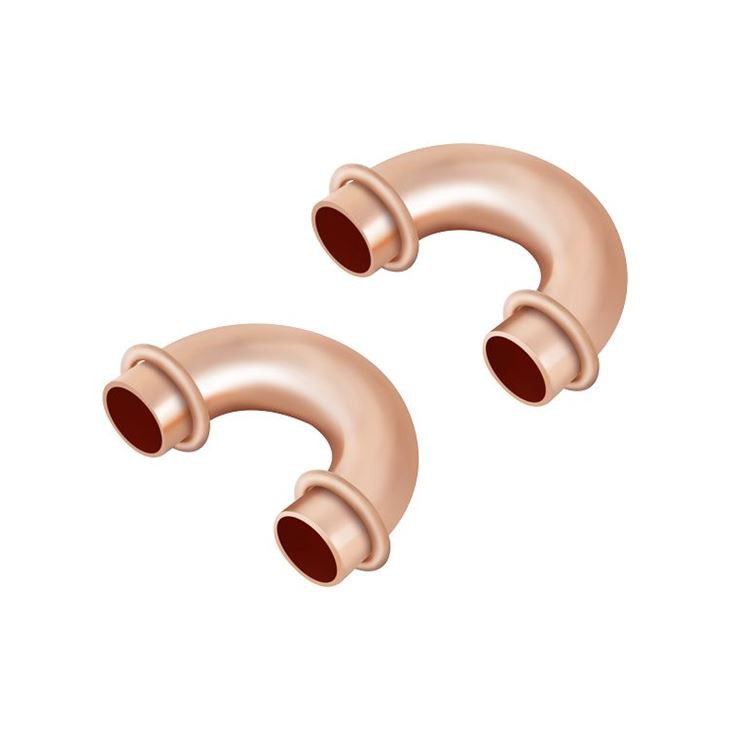
To ensure the accuracy of the bend angle, we use angle measurement tools. For example, a protractor or a digital angle gauge can be used to measure the angle of the U bend. The most common bend angles for copper U bend fittings are 90 degrees and 180 degrees. In the case of 180 Degree Copper U Return Bend, a precise 180 - degree bend is essential for proper installation in air - conditioning and refrigeration systems.
The bend radius is another critical parameter. It should be consistent throughout the bend to ensure smooth fluid flow inside the tube. Any irregularities in the bend radius can cause turbulence, which may lead to increased pressure drop and reduced system efficiency.
Surface Quality Inspection
After the bending process, the surface quality of the copper U bend fittings is inspected. The surface should be smooth and free of any scratches, dents, or cracks. Scratches can act as stress concentration points, which may lead to premature failure of the fitting. Dents can also affect the flow of fluid inside the tube and may cause blockages.
We use visual inspection methods to check for surface defects. Trained inspectors carefully examine each fitting under proper lighting conditions. In addition to visual inspection, we may also use non - destructive testing methods such as ultrasonic testing to detect any internal cracks or defects that are not visible to the naked eye.
The surface finish of the copper U bend fittings also affects its corrosion resistance. A smooth surface finish reduces the likelihood of corrosion by minimizing the area where corrosive substances can accumulate. We ensure that the surface finish meets the relevant standards, which may involve processes such as polishing or passivation to enhance the corrosion resistance of the copper.
Heat Treatment (if applicable)
In some cases, copper U bend fittings may undergo heat treatment to improve their mechanical properties. Heat treatment can relieve internal stresses generated during the bending process and enhance the ductility and strength of the copper.
The heat treatment process is carefully controlled. We use a furnace with precise temperature control to ensure that the copper reaches the appropriate heat treatment temperature. The temperature, heating rate, and holding time are all critical factors. For example, if the temperature is too high or the holding time is too long, it may cause the copper to become overly soft or develop a coarse grain structure, which can reduce its strength.
After heat treatment, the mechanical properties of the copper U bend fittings are tested again. Tensile strength, yield strength, and elongation are measured to ensure that they meet the design requirements. These mechanical properties are important as they determine the fitting's ability to withstand the pressure and stress in the system.
Leak Testing
Leak testing is a crucial quality control step for copper U bend fittings, especially for applications in air - conditioning and refrigeration systems where any leakage can lead to significant performance issues and environmental concerns.

We use different methods for leak testing, depending on the application and the required sensitivity. One common method is the pressure decay test. In this test, the fitting is sealed and pressurized with a gas (usually air or nitrogen). The pressure is then monitored over a period of time. If there is a leak, the pressure will decrease. The rate of pressure decay is used to determine the size of the leak.
Another method is the bubble test. The fitting is submerged in a liquid (usually soapy water), and if there is a leak, bubbles will form at the leak point. This method is simple and can quickly identify large leaks.
For more sensitive applications, helium mass spectrometry leak testing may be used. Helium is a very small molecule that can easily detect even the smallest leaks. The fitting is placed in a test chamber, and helium is introduced into the chamber. Any helium that leaks through the fitting is detected by a mass spectrometer, which can accurately measure the leak rate.
Final Inspection and Packaging
Before the copper U bend fittings are shipped to customers, a final inspection is carried out. This inspection is a comprehensive check that includes all the previous quality control steps. The dimensions, bend angle, surface quality, and leak test results are reviewed to ensure that the fitting meets all the specifications.
Once the fitting passes the final inspection, it is carefully packaged. The packaging is designed to protect the fitting during transportation and storage. We use materials such as plastic bags, cardboard boxes, or wooden crates, depending on the size and quantity of the fittings. The packaging also includes labels with important information such as the product name, size, quantity, and manufacturing date.
Conclusion
In conclusion, the quality control process for copper U bend fittings is a multi - step and comprehensive process that covers every aspect from raw material inspection to final packaging. As a supplier, we are committed to maintaining the highest quality standards to ensure that our customers receive reliable and high - performance copper U bend fittings.
If you are in need of high - quality Ac Copper Fittings or Crossover Bend Copper Fittings, we invite you to contact us for procurement and further discussion. We are always ready to provide you with the best products and services to meet your specific needs.
References
- ASTM International. ASTM B280 - Standard Specification for Seamless Copper Tube for Air - Conditioning and Refrigeration Field Service.
- ASHRAE Handbook - Refrigeration. American Society of Heating, Refrigerating and Air - Conditioning Engineers.


