


Hey there! As a supplier of refrigeration filter driers, I often get asked about the maximum operating temperature for these nifty little devices. So, I thought I'd sit down and write a blog post to share what I know.
First off, let's talk about what a refrigeration filter drier actually does. In a nutshell, it's a crucial component in any refrigeration or air - conditioning system. Its main jobs are to filter out any debris, like dirt, metal shavings, or other particles that might be floating around in the refrigerant, and to absorb any moisture. Moisture in a refrigeration system can cause all sorts of problems, like corrosion, ice formation in the expansion valve, and reduced efficiency.
Now, to the main question: what's the maximum operating temperature for a refrigeration filter drier? Well, it can vary quite a bit depending on a few factors.
Factors Affecting the Maximum Operating Temperature
Type of Refrigerant
Different refrigerants have different properties, and they can interact with the filter drier materials in various ways. For example, some older refrigerants like R - 22 were commonly used in the past, but they're being phased out due to their ozone - depleting potential. Newer refrigerants, such as R - 410A, are more environmentally friendly but may have different temperature requirements.
R - 410A systems generally operate at higher pressures and temperatures compared to R - 22 systems. A filter drier designed for an R - 410A system needs to be able to handle these elevated conditions. Typically, for systems using R - 410A, the maximum operating temperature for a well - designed filter drier can be around 120°C (248°F).
Construction Materials
The materials used to build the filter drier play a huge role in determining its maximum operating temperature. Most filter driers have a metal shell, often made of copper or steel. Copper is a popular choice because it's a good conductor of heat and is relatively corrosion - resistant.
The desiccant inside the filter drier, which is responsible for absorbing moisture, also has temperature limits. Silica gel and molecular sieves are common desiccants. Molecular sieves are generally more heat - resistant than silica gel. A filter drier with a molecular sieve desiccant can usually tolerate higher temperatures. For instance, some high - quality filter driers with molecular sieve desiccants can operate at temperatures up to 130°C (266°F) without significant degradation of the desiccant's performance.
System Design
The overall design of the refrigeration or air - conditioning system can impact the filter drier's operating temperature. If the system has poor ventilation or if there are components that generate a lot of heat nearby, the filter drier may be exposed to higher temperatures than normal.
In a well - designed system, the filter drier is placed in a location where it can dissipate heat effectively. However, in some compact or poorly laid - out systems, the heat may build up around the filter drier, reducing its maximum safe operating temperature.
Typical Maximum Operating Temperatures
On average, most standard refrigeration filter driers have a maximum operating temperature in the range of 100°C - 120°C (212°F - 248°F). This range is suitable for a wide variety of applications, from small domestic refrigerators to medium - sized commercial air - conditioning systems.
For more heavy - duty industrial refrigeration systems, where the temperatures can be much higher, specialized filter driers are available. These can handle temperatures up to 150°C (302°F) or even higher in some cases. But these are usually custom - designed and more expensive.
Why Does the Maximum Operating Temperature Matter?
Exceeding the maximum operating temperature of a filter drier can lead to several problems. First of all, the desiccant can start to break down. When the desiccant breaks down, it loses its ability to absorb moisture effectively. This can result in moisture remaining in the refrigerant, which as I mentioned earlier, can cause corrosion and other issues in the system.
Secondly, the high temperature can cause the metal shell of the filter drier to expand and contract, potentially leading to leaks. A leak in the filter drier can allow refrigerant to escape, reducing the system's efficiency and potentially causing environmental problems.
Our Product Range
As a supplier, we offer a wide range of refrigeration filter driers to suit different applications and temperature requirements. Our Refrigerator Dryer Filter is perfect for small - scale refrigeration units, like home refrigerators and freezers. It's designed to operate within the typical temperature range of 100°C - 120°C (212°F - 248°F) and provides reliable moisture absorption and particle filtration.

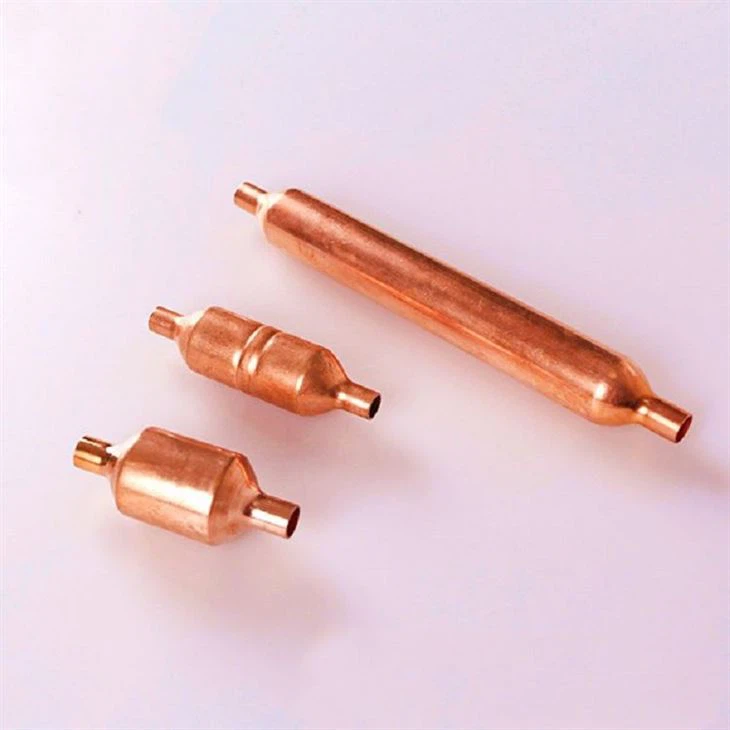
For larger air - conditioning systems, our Air Conditioner Copper Driers are a great choice. They're made with high - quality copper and a heat - resistant desiccant, allowing them to handle slightly higher temperatures.
If you're dealing with an industrial refrigeration system, our Refrigeration Copper Filter Drier is designed to withstand the rigors of high - temperature operation. It can handle temperatures up to 150°C (302°F) and is built to last.
Contact Us for Procurement
If you're in the market for a refrigeration filter drier, whether it's for a small project or a large - scale industrial application, we'd love to hear from you. We can help you choose the right filter drier based on your specific temperature requirements and system design. Just reach out to us, and we'll start the procurement discussion. We're here to ensure that you get the best - performing filter drier for your needs.
References
- ASHRAE Handbook of Refrigeration.
- Manufacturer's specifications for refrigeration filter driers.
- Technical papers on refrigeration system design and component performance.


